


















Seoul, South Korea-
On Tuesday, South Korean authorities reported that North Korea detonated explosives on sections of two significant roads linking to the southern region of the peninsula. This action followed Pyongyang’s warning of its intention to sever all connections with the South.
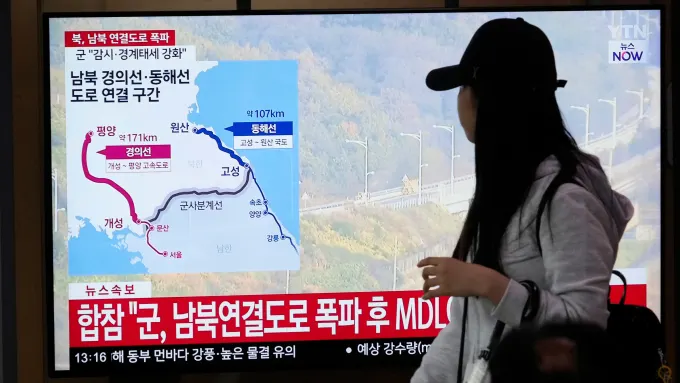
The Gyeongui line on the West coast and the Donghae line on the East coast, both crucial road and railway connections between the two Koreas, were targeted around noon local time, as stated by Seoul’s Joint Chiefs of Staff (JCS).
While the destruction of these routes has minimal practical impact—given that the two Koreas are separated by one of the most heavily fortified borders in the world and these roads have remained unused for years—the act carries significant symbolic weight amid heightened tensions between the leaders of both nations.
Footage released by the South Korean Defense Ministry depicted multiple explosions occurring on the northern side of the military demarcation line. Subsequently, heavy machinery, including trucks and excavators, was observed at one of the affected roads, which was partially obstructed by a black barrier. The JCS noted that North Korea was engaged in “additional works with heavy machinery” at the site, although no further details were provided.
In reaction to the detonations, the South Korean military fired warning shots in the vicinity south of the military demarcation line and is actively monitoring North Korean military activities, maintaining a “fully ready posture in cooperation with the United States,” according to the JCS.
On Monday, South Korea announced that it had observed indications of North Korea’s intent to dismantle the roads linking the two nations, cautioning that explosions could occur at any moment. The Defense Ministry indicated that the military had enacted countermeasures, although specific details were not disclosed.
A representative from the Joint Chiefs of Staff, Lee Sung-joon, reported that the South Korean military had identified individuals working behind barriers erected on the northern side of the border.
These potential detonations follow North Korea’s recent accusations against South Korea for deploying drones filled with propaganda over its capital, Pyongyang, and its subsequent threats of “retaliation.” This incident marks the latest exchange in a series of provocations, which have included North Korea sending balloons laden with refuse into the South.
Last week, North Korea’s military issued a warning that it would undertake a “substantial military step” to entirely sever its territory from South Korea, following North Korean leader Kim Jong Un’s decision to abandon a long-standing policy aimed at peaceful reunification earlier this year.
Since the conclusion of the Korean War in 1953, which ended with an armistice agreement, North and South Korea have remained divided. Although both governments have historically aspired to reunification, tensions have persisted.
In January, Kim declared that North Korea would cease its pursuit of reconciliation and reunification with South Korea, characterizing inter-Korean relations as “a relationship between two hostile countries and two belligerents at war,” as reported by KCNA at that time.
An ‘acute military situation’
On October 9, the general staff of the Korean People’s Army (KPA) announced through the state-run news agency KCNA that all remaining roads and railways linking to the South would be entirely severed, thereby obstructing access along the border.
“The current tense military situation on the Korean peninsula necessitates that the armed forces of the DPRK adopt more decisive and robust measures to effectively safeguard national security,” the statement indicated, referring to North Korea by its official name, the Democratic People’s Republic of Korea.
The general staff attributed these actions to recent “military exercises” conducted in South Korea and the presence of what it claims are US strategic nuclear assets in the area. Over the past year, various US military assets, including an aircraft carrier, amphibious assault ships, long-range bombers, and submarines, have made visits to South Korea, provoking strong condemnation from Pyongyang.
Since January, North Korea has enhanced its border defenses by laying land mines, constructing anti-tank barriers, and dismantling railway infrastructure, as reported by the South Korean military.
Additionally, the leaders of North and South Korea have intensified their use of aggressive rhetoric.
Earlier this month, Kim Jong Un issued a warning regarding the potential use of nuclear weapons against South Korea in the event of an attack, following a statement from South Korea’s president indicating that any nuclear aggression from the North would lead to the “end of its regime.”
These remarks coincide with an apparent escalation in North Korea’s nuclear production activities and a strengthening of its relationship with Russia, which has heightened concerns in the West regarding the trajectory of the isolated nation.
Leif-Eric Easley, a professor at Ewha Womans University in Seoul, posits that North Korea’s strategy to sever ties with the South may serve as a means for Kim to “divert attention from its economic shortcomings and justify its expensive missile and nuclear arms development” by amplifying perceived external threats.
“Kim Jong Un aims to project an image of military strength to both domestic and international audiences, yet his actions may stem from underlying political vulnerabilities,” he stated. “The threats posed by North Korea, whether tangible or rhetorical, are indicative of a regime survival strategy characteristic of a hereditary dictatorship.”