












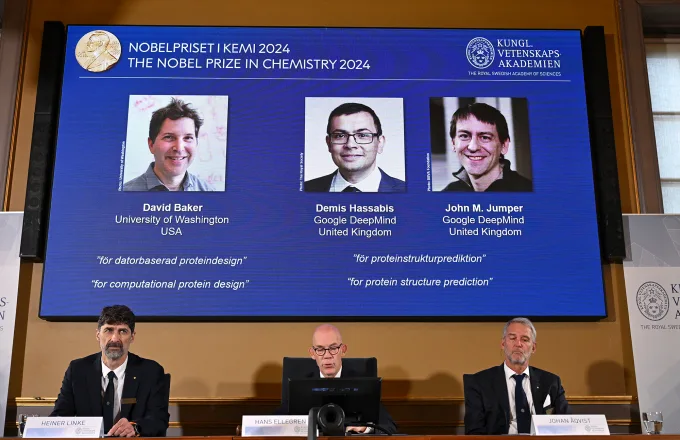
The 2024 Nobel Prize in Chemistry has been conferred upon three scientists who utilized artificial intelligence to decipher the structures of nearly all known proteins, which are fundamental components of life.
The Nobel Committee recognized David Baker for achieving the remarkable task of creating entirely new types of proteins, while Demis Hassabis and John Jumper were acknowledged for their development of an AI model capable of predicting the intricate structures of proteins—a challenge that had remained unresolved for five decades.
“The potential of their discoveries is enormous,” stated the committee during the announcement made in Sweden on Wednesday. This prestigious award, regarded as the highest honor in scientific achievement, includes a monetary prize of 11 million Swedish kronor (approximately $1 million).
Proteins, composed of chains of amino acid molecules, serve as the essential building blocks of life. They contribute to the formation of hair, skin, and tissue cells; they are involved in the processes of reading, copying, and repairing DNA; and they facilitate the transport of oxygen in the bloodstream.
Although proteins are constructed from only about 20 different amino acids, these can be arranged in virtually limitless combinations, folding into highly intricate three-dimensional structures.
A search on Google for protein structures
The committee announced that the prize awarded on Wednesday was divided into two parts. The first portion was granted to Hassabis, a British computer scientist and co-founder of Google’s AI research facility, DeepMind, along with Jumper, an American researcher affiliated with DeepMind as well.
Hassabis and Jumper received recognition for their innovative application of artificial intelligence in predicting the three-dimensional structures of proteins based on amino acid sequences, enabling them to forecast the structures of nearly all 200 million identified proteins.
Their AI initiative, known as the AlphaFold Protein Structure Database, has been utilized by over 2 million researchers globally. This platform serves as a “Google search” for protein structures, offering immediate access to predicted protein models and thereby expediting advancements in fundamental biology and associated disciplines. The duo has previously been awarded the 2023 Lasker Prize and the Breakthrough Prize.
Since the publication of the pair’s seminal paper in 2021, it has garnered over 13,000 citations. David Pendlebury, the head of research analysis at Clarivate’s Institute for Scientific Information, characterized this figure as “exceptional.” He noted to CNN prior to the prize announcement on Wednesday that among a total of 61 million scientific papers, only approximately 500 have achieved more than 10,000 citations.
The second portion of the prize was awarded to Baker, an American biochemist and professor at the University of Washington, for his innovative use of computational techniques to design proteins that had not previously existed and possess entirely novel functions. Johan Aqvist, a member of the Nobel committee, explained that Baker initially employed his computer program to “visualize protein structures in new dimensions” and subsequently determined the amino acid sequences necessary to create these structures. This process enabled Baker to synthesize new proteins, the majority of which had never been observed before and were not found in nature.
He remarked that the array of proteins developed by Baker was “truly astonishing.”
“It appears that this technology allows for the near-complete construction of any type of protein,” Aqvist noted. The committee emphasized that the ability to create new proteins holds immense potential for various applications, including the development of innovative pharmaceuticals and the expedited creation of vaccines.
The chemistry prize awarded on Wednesday has underscored the significant impact of artificial intelligence in the field of science.
The Nobel Prize in physics, presented on Tuesday, was jointly awarded to Geoffrey Hinton, often referred to as the “Godfather of AI,” and John Hopfield, in recognition of their contributions to artificial neural networks—technology that has also been foundational to the achievements of the recent chemistry laureates.
Prior to their focus on proteins, the duo developed a computer program capable of competing against the world’s leading players in the ancient Chinese board game Go.