

















Delhi:
On Tuesday, a significant number of rockets were launched at Israel from both Gaza and Lebanon, as the ongoing conflict with Hamas, which marked its one-year anniversary on October 7, poses a risk of escalating into a broader regional confrontation.
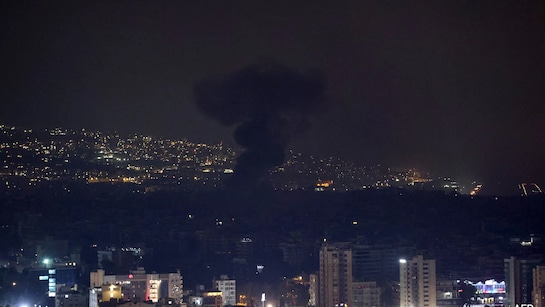
Hezbollah, a Lebanese group supported by Iran, announced that it had struck an Israeli military intelligence facility near Tel Aviv on Monday, as reported by the AFP news agency. The group claimed to have fired “a salvo of rockets at the Glilot base of military intelligence unit 8200 located on the outskirts of Tel Aviv.” Additionally, Reuters indicated that Hezbollah targeted a military installation south of Haifa with “Fadi 1” missiles and executed another attack on Tiberias, situated 65 kilometers (40 miles) away.
According to Israeli officials, Hezbollah operatives in Lebanon launched approximately five rockets towards Israel, triggering sirens in the Tel Aviv area but resulting in no reported injuries. Residents in the vicinity reported hearing explosions in the sky above Israel. The Israeli military confirmed that several rockets were intercepted, while others fell in uninhabited regions.
Earlier on Monday, Israeli air forces carried out extensive airstrikes across Lebanon, particularly in the Beqaa Valley and Beirut, targeting over 120 Hezbollah positions, which included infrastructure, launch sites, command and control centers, and a facility for storing weapons.
The armed factions of Hamas and Islamic Jihad reported that their fighters engaged Israeli forces in the northern region using anti-tank rockets, resulting in casualties among the Israeli troops. The Al-Qassam Brigades of Hamas asserted that they successfully struck an Israeli armored personnel carrier with a Yassin 105 missile in the Tuwam area, situated north of Gaza City.
Concurrently, the Israeli military conducted targeted operations against Hezbollah in southwestern Lebanon, intensifying its ground activities along the coastline following the deployment of additional troops.
Israel also advanced its tank operations deeper into Jabalia in the northern Gaza Strip, urging residents to evacuate as it conducted aerial bombardments on a Palestinian refugee camp. Although Palestinian health officials did not immediately release updated casualty figures, they indicated that dozens had lost their lives in the Gaza Strip over the past 24 hours. The Israeli military confirmed the death of one soldier during combat in northern Gaza and stated that numerous Palestinian militants had been killed, while weapons were located and military infrastructure dismantled during operations in Jabalia.
Memorials across the region and globally commemorated the lives lost on both sides during the October 7 Hamas attack last year, which targeted communities and security installations. The health ministry in Hamas-controlled Gaza reported that over 41,000 individuals, predominantly civilians, have died since the onset of the conflict. Approximately 100 out of 250 hostages remain unaccounted for.
A significant portion of Gaza lies in devastation, with tens of thousands of casualties, more than half of whom are women and children. The vast majority of Gaza’s population, totaling 2.3 million, has been displaced, with many compelled to endure harsh conditions in refugee camps. The Lebanese population is apprehensive about experiencing a similar situation, as Israeli airstrikes have already displaced 1.2 million individuals.
In the meantime, Israeli Prime Minister Benjamin Netanyahu has asserted that Israel “will persist in its fight” against its adversaries. He stated, “As long as the enemy poses a threat to our existence and the peace of our nation, we will continue to engage in combat. We will not relent until our hostages are returned from Gaza. I will not abandon any of them.”
Is a ceasefire unattainable?
Attempts at ceasefire agreements between the conflicting parties have repeatedly failed, despite the involvement of various nations. Recently, French Foreign Minister Jean-Noël Barrot urged for ceasefires in both Gaza and Lebanon, expressing France’s readiness to facilitate de-escalation in the region.
Barrot reaffirmed France’s steadfast commitment to Israel’s security, emphasizing that “force alone cannot ensure Israel’s safety.” His remarks followed a call from French President Emmanuel Macron.
Displaced individuals are resting on mattresses in the open air along the Ain al-Mreisseh seaside promenade in central Beirut.
Photo Credit: AFP
According to CNN, the United States is not currently making efforts to revive the ceasefire agreement, focusing instead on influencing and constraining Israeli military actions in Lebanon and against Iran, rather than ceasing hostilities. The previous proposal suggested a 21-day cessation of fighting between Israel and Hezbollah to facilitate the return of Israeli and Lebanese civilians to their homes.
China has announced it will supply medical aid to Lebanon.
The China International Development Cooperation Agency, the official foreign aid agency of China, stated that the Chinese government has decided to provide emergency humanitarian medical supplies to Lebanon at the request of the Lebanese government to assist in medical efforts.
World leaders reflect on a “dark day.”
US President Joe Biden reaffirmed his dedication to Israel’s security while also characterizing October 7 as a “dark day for the Palestinian people.”
A report from Brown University’s Watson Institute indicates that the United States has allocated $22.76 billion to support Israel’s military actions in Gaza and operations against the Houthis in Yemen. The $17.9 billion in military aid to Israel since the onset of the Gaza conflict represents the highest annual total recorded, comprising military financing and transfers from US weapon stockpiles, as reported by Al Jazeera.
In the UK, Prime Minister Keir Starmer has urged for renewed diplomatic initiatives to restore peace in the region, stating, “The region cannot endure another year of this; civilians on all sides have suffered too much. All parties must now step back from the brink and demonstrate the courage to exercise restraint.”
In Strasbourg, Members of the European Parliament held a minute of silence. European Parliament President Roberta Metsola remarked, “There is nothing that could ever justify the indiscriminate mass murder, rape, kidnapping, and torture that occurred a year ago.”