

















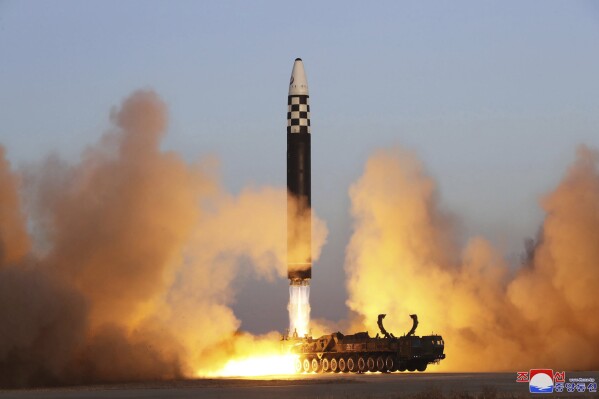
North Korea launched several suspected ballistic missiles on Thursday, shortly after Kim Jong Un’s space program suffered a setback when a rocket exploded shortly after takeoff.
South Korea’s military detected approximately twelve projectiles believed to be short-range ballistic missiles fired from an area near Pyongyang’s main international airport towards the east at around 06:14 a.m., as reported by the Joint Chiefs of Staff in a message to journalists.
The military stated, “Our surveillance and vigilance have been intensified in anticipation of further launches,” emphasizing that South Korea is fully prepared by sharing information on the ballistic missiles closely with US and Japanese authorities.
According to Japan’s Coast Guard, a ballistic missile-like object has been observed falling, with the projectile likely landing outside Japan’s exclusive economic zone, as reported by national broadcaster NHK.
North Korea typically refrains from commenting on missile launches until the day following the event.
This marks the sixth ballistic missile test conducted by Kim’s regime this year. The previous ballistic missile launch by North Korea occurred approximately two weeks ago, involving the firing of multiple short-range rockets. Just before that launch, Kim Yo Jong, the leader’s sister, criticized allegations that North Korea had been supplying munitions to Russia produced by the US and some of its allies.
Despite the failure of the rocket intended to deploy a spy satellite on Monday, Kim Jong Un has vowed to continue advancing his space program. The US, South Korea, and Japan have expressed concerns that the rocket technology used by North Korea contributes to its ballistic missile program, violating United Nations Security Council resolutions.
According to official media, Kim plans to launch three spy satellites in 2024, as discussed during a policy-setting meeting of top officials in late December. These satellites will enable him to monitor US troops in the area and enhance his ability to target specific locations as he upgrades his nuclear weapons arsenal.
In addition, Kim Jong Un has issued a warning to South Korea, stating that their actions, such as conducting air exercises near the border, are a threat to his country’s sovereignty. As a response, North Korea has sent balloons filled with various items, including trash, into South Korea. South Korea’s military has reported these activities.
The US, South Korea, and other countries have accused North Korea of sending a significant number of artillery shells and their latest family of short-range nuclear-capable ballistic missiles to Russia. These missiles are easily concealable and can be rapidly deployed. The US and its allies claim that these munitions are intended for use in Ukraine’s conflict, but both Pyongyang and Moscow have denied these allegations.
South Korean Defense Minister Shin Wonsik has suggested that the recent weapons tests overseen by Kim Jong Un may serve as a demonstration before exporting the arms to Russia for President Vladimir Putin’s use in his neighboring country. Shin has also stated that Russia is providing North Korea with food, raw materials, and components used in weapons production. The provision of food aid has helped stabilize prices for essential goods in North Korea. If the arms transfers continue to grow, Russia is likely to provide more military technology to Kim, thereby increasing the threat posed by Pyongyang to the region.