


















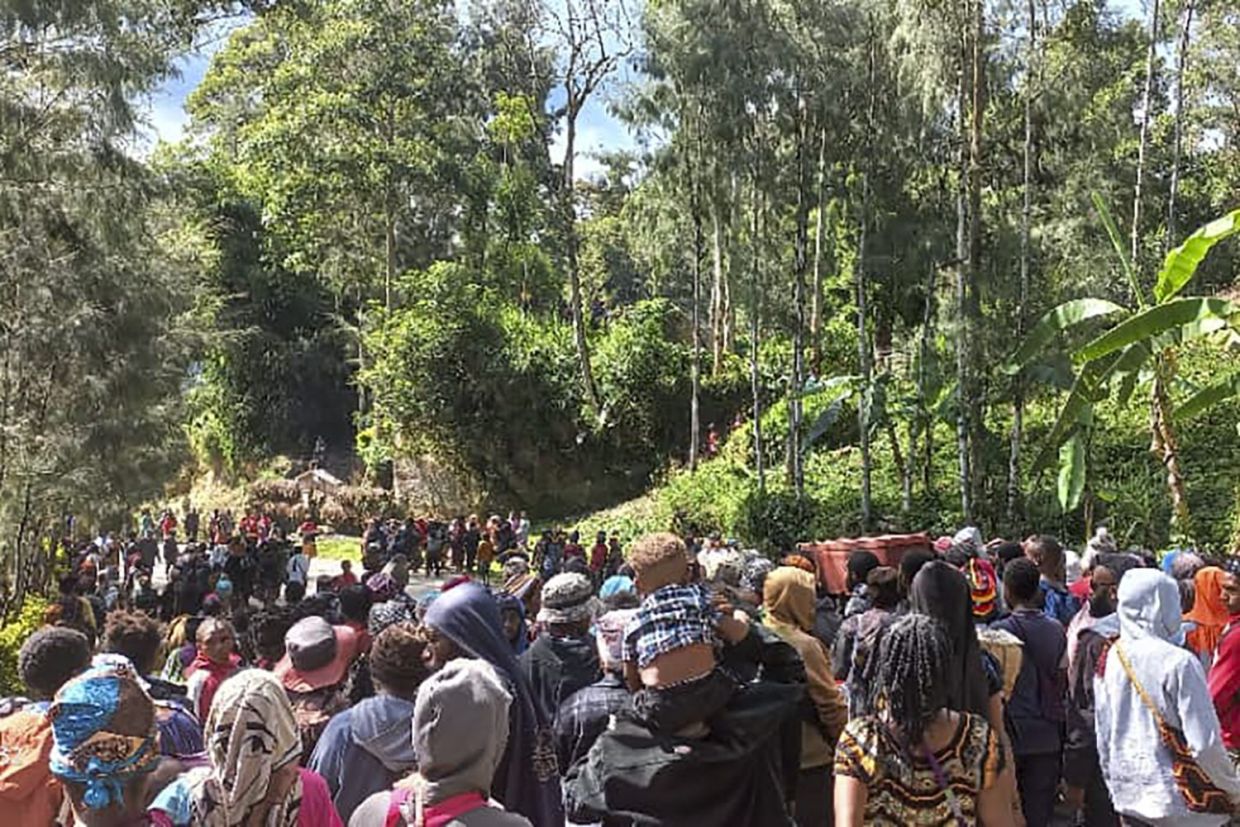
The government of Papua New Guinea reported that a landslide occurred on Friday, burying over 2,000 individuals and has officially requested international assistance.
The official number provided by the government is about three times higher than the United Nations’ estimation of 670.
As stated in a letter received by The Associated Press that was addressed to the United Nations resident coordinator on Sunday, the acting director of the National Disaster Center of the South Pacific island nation mentioned that the landslide had “buried more than 2000 individuals alive” and caused “significant devastation”.
Various estimates regarding the number of casualties have been circulating since the disaster took place, and details on how officials determined the total number of individuals affected remain unclear.
On Monday, Australia made preparations to dispatch aircraft and other resources to aid in the aftermath of a fatal landslide in Papua New Guinea. Concerns arose due to overnight rainfall in the mountainous interior of the South Pacific nation, which could potentially lead to the tons of debris that had engulfed hundreds of villagers becoming precarious.
Australian Defence Minister Richard Marles noted that his team has been engaged in discussions with Papua New Guinea officials since Friday, when a mountainside crumbled onto Yambali village in Enga province. The United Nations projected that the landslide resulted in the deaths of 670 people, yet only six individuals have been recovered thus far.
Marles informed the Australian Broadcasting Corp., “The specific form of assistance we offer will unfold over the next few days. We have the capability for airlifting individuals there. Additionally, there might be additional equipment we can provide for search and rescue efforts. We are currently discussing all these aspects with PNG.”
Papua New Guinea is Australia’s closest neighbor, and the two nations are fostering stronger defense relations as part of Australia’s endeavor to counter the escalating influence of China in the region. Australia is also the principal contributor of foreign aid to its former colony, which gained independence in 1975.
Heavy rainfall persisted for a duration of two hours overnight in the provincial capital of Wabag, located 60 kilometers (35 miles) away from the devastated village. Unfortunately, there was no immediate weather report available from Yambali due to limited communication in the area.
Concerns arose among emergency responders regarding the potential impact of the rain on the already precarious mass of debris, which spans 6 to 8 meters (20 to 26 feet) deep over an area equivalent to three to four football fields.
A significant development occurred when a local builder donated an excavator on Sunday, marking the first instance of heavy earth-moving machinery being deployed to assist villagers who have been tirelessly digging with shovels and farming tools in search of bodies. The challenging task of working amidst the shifting debris poses a serious risk.
Serhan Aktoprak, the head of the International Organisation for Migration’s mission in Papua New Guinea, highlighted the growing danger of water seeping through the debris and the underlying earth, heightening the likelihood of another landslide. Aktoprak anticipated receiving updates on the weather conditions in Yambali by Monday afternoon.
Expressing personal concern, Aktoprak emphasized the critical importance of monitoring the weather conditions, given the ongoing land movements and rock falls in the area.
In a proactive move, Papua New Guinea’s defense minister, Billy Joseph, and the National Disaster Center director, Laso Mana, flew via an Australian military helicopter from the capital of Port Moresby to Yambali, situated 600 kilometers (370 miles) to the northwest, to assess the situation firsthand and determine the necessary requirements.
A photo shared by Mana’s office depicted him at Yambali presenting a local official with a check amounting to 500,000 kina (USD 130,000) to procure emergency supplies for the 4,000 displaced survivors.
The reason for the visit was to determine if the government of Papua New Guinea should formally seek additional international assistance.
Papua New Guinea’s military was transporting earth-moving equipment to the disaster site, located 400 kilometers (250 miles) away from the city of Lae on the east coast.
Officials reported that traumatized villagers are in disagreement regarding the use of heavy machinery to excavate and potentially disturb the remains of their deceased family members.