


















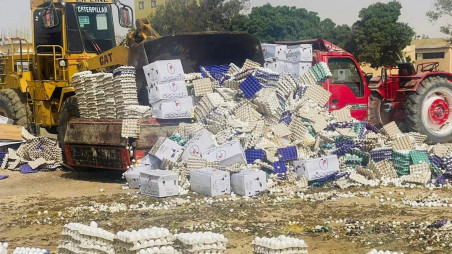
Some of the food supplies destined for the Gaza Strip from Egypt are beginning to spoil due to the continued closure of the Rafah border crossing for aid deliveries.
This closure has left the people in the Palestinian territory facing increased hunger.
Rafah used to serve as a crucial entry point for humanitarian aid and certain commercial goods until Israel intensified its military operations on the Gaza side of the border on May 6 and took control of the crossing from the Palestinian authorities.
Egyptian officials and sources have expressed concerns that military activities are jeopardizing humanitarian operations and are urging Israel to return control of the crossing to the Palestinians in order to resume operations. Egypt is also apprehensive about the possibility of Palestinians being displaced from Gaza.
Recently, Egypt and the US have agreed to send aid through Israel’s Kerem Shalom crossing until the necessary legal arrangements are made to reopen Rafah from the Palestinian side, as announced by the Egyptian presidency.
That could alleviate the backlog of assistance along the route connecting the Egyptian side of the crossing to the town of al-Arish, located approximately 45 km west of Rafah and serving as a destination for international aid contributions. However, this intervention comes too late to salvage certain food supplies.
According to Mahmoud Hussein, a truck driver, his cargo has been sitting on his vehicle for a month, gradually spoiling under the sun. Some of the food items are being discarded, while others are being sold at a discounted price.
“Apples, bananas, chicken, and cheese – many things have become rotten. Some items have been returned and are being sold for a quarter of their original price,” he lamented, seeking shelter from the scorching sun beneath his truck.
“Unfortunately, the onions we are transporting will most likely be consumed by animals due to the presence of worms in them.”
Aid deliveries to Gaza via Rafah commenced in late October, two weeks after the onset of the conflict between Israel and the Palestinian militant group Hamas.
Aid officials report that the flow of relief has frequently been hindered by Israeli inspections and military operations within Gaza. Consequently, supplies have become stranded in al-Arish or on the road to Rafah, resulting in transportation and storage costs.
A global hunger monitoring organization has issued a warning about an impending famine in certain parts of Gaza, which is home to 2.3 million people.
According to UN data, since May 7, no trucks have passed through Rafah, and only a few have gone through Kerem Shalom. In total, just over 900 truckloads have entered Gaza since that date, significantly lower than the minimum of 500 trucks per day that the UN deems necessary.