

















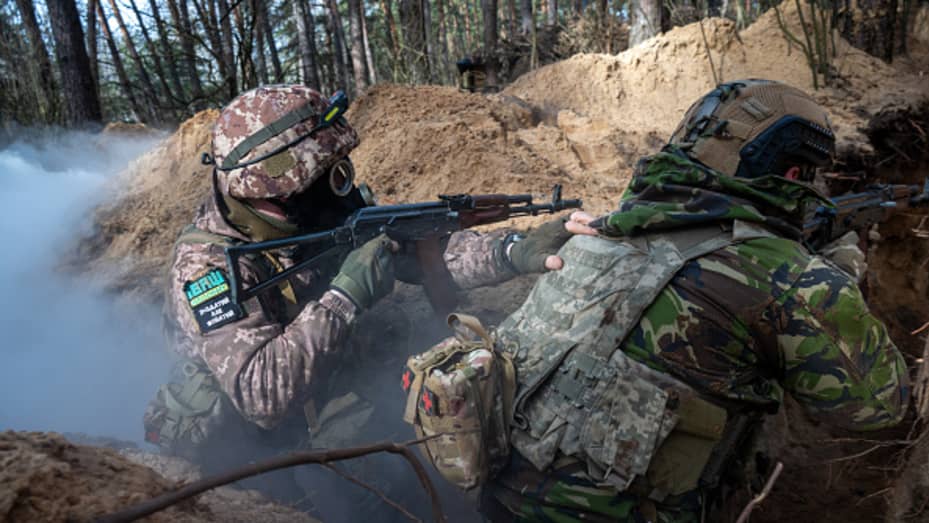
On May 1, the U.S. State Department made a declaration accusing Russia of violating the Chemical Weapons Convention by utilizing the chemical weapon chloropicrin against Ukrainian forces.
Additionally, the State Department announced the imposition of fresh sanctions on Moscow. In their factsheet, the U.S. State Department further stated that Russia had employed riot control agents, specifically tear gas, as a method of warfare in Ukraine, which is also a violation of the CWC.
According to the State Department, the use of these chemicals is not an isolated incident and is likely driven by Russia’s objective to dislodge Ukrainian forces from fortified positions and gain tactical advantages on the battlefield.
Chloropicrin, the chemical in question, is both a warfare agent and a pesticide. It poses a health risk if inhaled and is known to have irritating and tears-inducing effects on humans.
The U.S. National Institutes of Health explains that chloropicrin is produced through a chemical reaction involving sodium hypochlorite and nitromethane or by combining chloroform with nitric acid. It was initially developed as a poison gas during World War I and has been used by both the Allied and Central Powers.
Chloropicrin is highly toxic, carcinogenic, and can induce vomiting, leading soldiers to remove their masks and inhale more of the gas or other dispersed gaseous agents.
The U.S. State Department also accused Russia of using tear gas, which is a type of lachrymatory agent that induces tears. Examples of tear gas include pepper spray and bromoacetone.
The deputy defense minister of Ukraine had suggested that the emissions could possibly be attributed to “white phosphorus munitions.” However, independent experts found little evidence to support these claims, prompting the U.S. and the U.K. to announce further investigations.
Despite Russia’s assertion that it no longer possesses a military chemical arsenal, there is mounting pressure for the country to be more transparent regarding the alleged use of toxic weapons.
According to the Organisation for the Prohibition of Chemical Weapons (OPCW) in 2017, Russia had reportedly destroyed a stockpile of 40,000 chemical weapons that it had previously declared. However, the following year, a Russian military officer named Sergei Skripal and his daughter Yulia were poisoned with a banned chemical weapon in the U.K.
In 2020, five testing laboratories affiliated with the OPCW confirmed that Russian political activist Alexei Navalny had been poisoned with a similar substance. These incidents have eroded trust in Russia’s claims of distancing itself from chemical weapons.