

















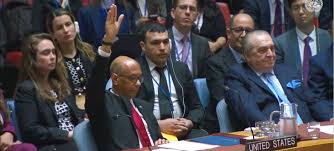
The United States has effectively prevented the United Nations from acknowledging a Palestinian state by using its veto power in the Security Council to block Palestinians from obtaining full membership in the organization.
A draft resolution proposing that “the State of Palestine be admitted to membership” of the UN was vetoed by the US, with Britain and Switzerland abstaining, and the remaining 12 council members voting in favor.
Russia’s UN Ambassador Vassily Nebenzia criticized the US for its stance on Palestinians, stating that Washington does not believe they deserve their own state and are merely an obstacle to Israel’s interests.
Deputy US Ambassador to the UN Robert Wood clarified that the US veto was not a rejection of Palestinian statehood, but rather an acknowledgment that it can only be achieved through direct negotiations between the parties.
Palestinian President Mahmoud Abbas condemned the US veto as “unfair, unethical, and unjustified,” while Palestinian UN Ambassador Riyad Mansour vowed to persist in their pursuit of full membership despite the resolution’s failure to pass.
The Palestinian quest for full UN membership coincided with Israel’s military campaign in Gaza and the expansion of settlements in the occupied West Bank.
According to reports from The Intercept, the US was allegedly pressuring Security Council members to reject Palestine’s bid for membership, as revealed in unclassified State Department cables.
Currently, the Palestinians hold the status of a non-member observer state, a form of de facto recognition of statehood granted by the UN General Assembly in 2012.
The Security Council must approve an application for full UN membership, followed by at least two-thirds of the General Assembly.
Britain’s UN ambassador Barbard Woodward emphasized that recognition of Palestinian statehood should not be the beginning of a new process, but it does not have to be the end either. Woodward stressed the importance of addressing the immediate crisis in Gaza first.
The UN Security Council has consistently supported the idea of two states coexisting peacefully within secure and recognized borders.
Palestinians seek a state in the West Bank, East Jerusalem, and the Gaza Strip, territories captured by Israel in 1967.
Algeria’s UN ambassador Amar Bendjama argued that admitting Palestinians to the United Nations would actually strengthen, rather than weaken, the two-state solution.
China’s representative at the United Nations, Zhang Jun, highlighted the urgency of Palestine’s full membership in the UN, emphasizing that the long-held dream of the Palestinian people must not be ignored.
The Palestinian Authority, led by Abbas, has limited self-governance in the West Bank, while Hamas took control of Gaza in 2007.
Israel has been engaged in a devastating conflict in Gaza since October, resulting in the deaths of over 34,000 people, predominantly women and children.
UN Secretary-General Antonio Guterres stressed the importance of supporting efforts to achieve lasting peace between Israel and a fully independent, viable, and sovereign Palestinian state, especially in light of recent escalations.
Failure to progress towards a two-state solution will only heighten volatility and risk for millions of people in the region, living under the constant threat of violence.